
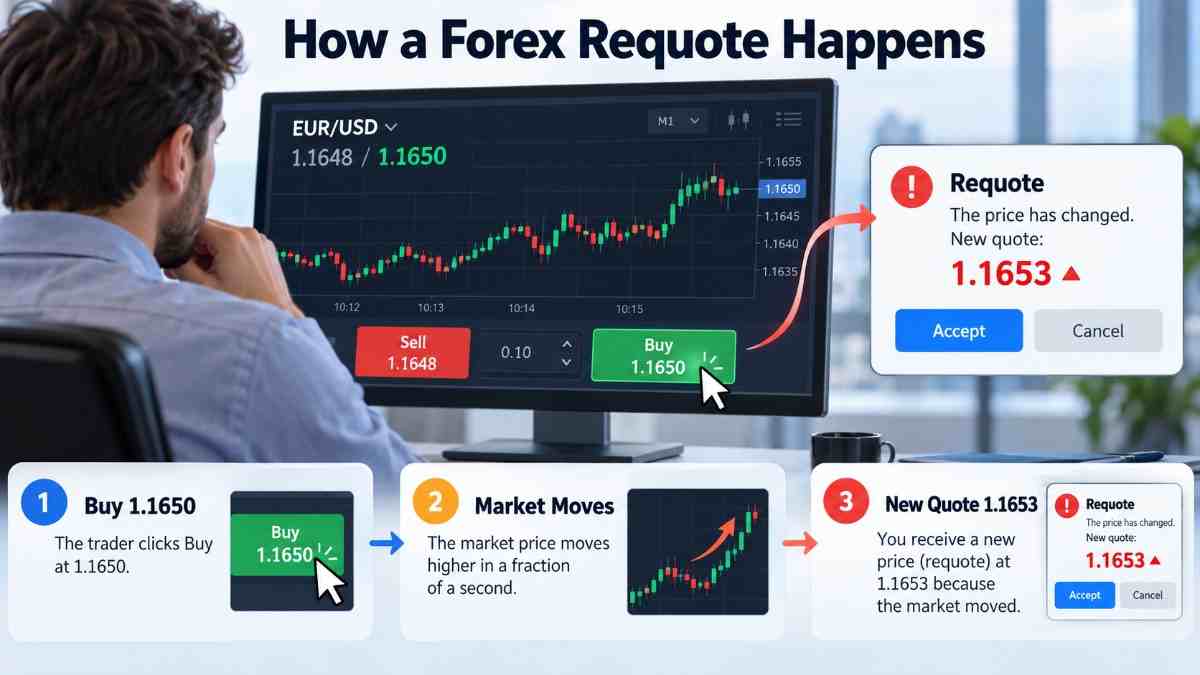
You click “Buy” on EUR/USD at 1.1650, but instead of opening the position, the platform returns a message offering 1.1653. The market has moved while the order was being processed, and the original quoted price is no longer being accepted. That is the basic idea behind forex requotes.
Requotes are most closely associated with execution models where the trader requests a specific price and the broker must confirm whether that price is still available. They are therefore different from slippage, where an order is executed at a different available price without first asking the trader to accept a replacement quote.
Understanding that distinction matters because not every price change during execution is evidence of a broker problem. Market volatility, execution mode, order settings and the time taken to process an instruction can all affect what happens between clicking the button and receiving the final result.
What Are Requotes in Forex?
The simplest answer to what are requotes in forex is that a requote occurs when the originally requested execution price is no longer accepted and the broker returns a new price at which the trade can be completed.
MetaTrader describes this most clearly under Instant Execution. When an order is submitted, the platform includes the current requested price. If the broker accepts that price, the order is executed; if it does not, a new price can be returned to the trader as a requote.
The current MetaTrader 5 execution documentation also allows traders to define acceptable price deviation under Instant Execution. If the market moves within that permitted range, the transaction can execute at the changed price without another confirmation. When the move exceeds the permitted deviation, the server can return a new quote instead.
This means forex requotes are fundamentally connected to how a specific execution model treats price changes while an order is being processed.
Why Forex Orders Get Requoted
The most common answer to why forex orders get requoted is that the requested price has changed before the broker can complete the instruction. Currency prices can update many times per second, so even a short delay can make the original quote stale.
Imagine EUR/USD is offered at 1.16500 when the trader presses Buy. While the instruction travels to the trading server, the available ask changes to 1.16525. If the account uses Instant Execution and the move exceeds the trader’s permitted deviation, the original order may not be accepted at 1.16500.
The platform can instead return 1.16525 and ask whether the trader wants to proceed. The trader can accept the new quote or reject it.
These forex broker requotes become more likely when prices are moving quickly, liquidity is changing or the permitted execution tolerance is extremely narrow.
Instant Execution and Forex Broker Requotes
Execution mode is central to understanding forex broker requotes. MetaTrader currently distinguishes Instant, Request, Market and Exchange Execution, although the available mode depends on how the broker configures the instrument.
Under Instant Execution, the requested price is part of the order. The broker either accepts it within the permitted conditions or returns a different price.
Request Execution follows a related principle. The trader first requests a quote, then decides whether to trade at the price offered. Because quoted prices are valid for only a limited period, the request can become stale if the trader waits too long.
This is different from Market Execution, where the trader agrees in advance to execution at the available broker price rather than insisting that one exact displayed quote be maintained.
The execution model therefore matters more than simply asking whether a broker “uses requotes.”
Forex Requotes vs Market Execution
A common misconception is that every broker can issue forex requotes on every market order. In practice, Market Execution is designed differently.
Under MetaTrader’s execution model, a Market Execution instruction allows the broker to execute the transaction at the available price without returning to the trader for a second discussion about that price. The resulting fill can therefore be different from the quote visible at the time the button was pressed.
That difference is normally discussed as slippage rather than a requote.
For traders, the distinction is a trade-off. Instant Execution can provide tighter control over an acceptable requested price but can lead to a new quote when the market moves too far. Market Execution generally reduces the classic requote process but exposes the trader more directly to price movement during execution.
Neither structure guarantees that every trade will occur at the exact number first visible on the screen.
Requote vs Slippage
The difference between requote vs slippage is one of the most important execution concepts for retail traders. A requote says, in effect: “The original price is unavailable. Here is a new price. Do you still want the trade?”
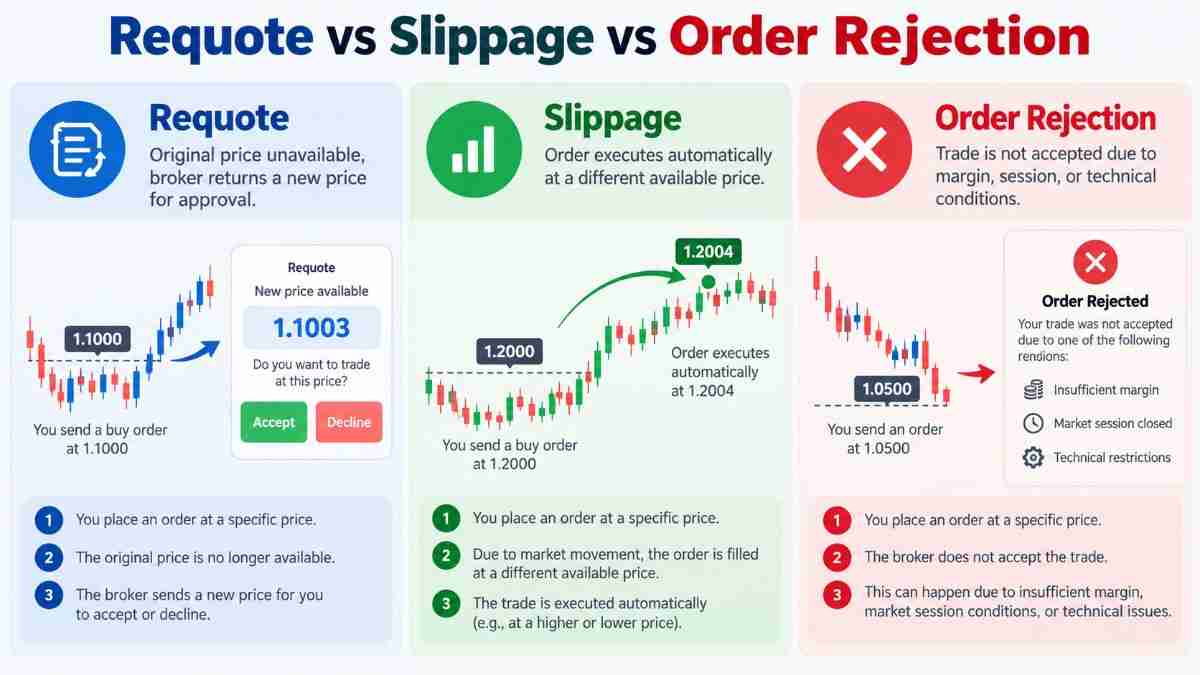
Slippage says: “The order was executed, but the available execution price differed from the price you saw or expected.” Consider two examples. A trader presses Buy at 1.1650 and receives a message asking whether they will accept 1.1653. That is a requote. If the trader presses Buy around 1.1650 and the order fills automatically at 1.1653, that is slippage.
Slippage can also be favourable. If a better price becomes available during execution and the broker’s methodology passes that improvement to the client, the actual fill can be better than expected.
The FXReviews guide to forex hedging also illustrates why execution quality matters when a trader is trying to open an offsetting position during a fast-moving event. A hedge that reaches the market late can produce a materially different exposure from the one originally intended.
A Requote Is Not the Same as Forex Order Rejection
Forex order rejection is another concept that should not be confused with a requote. A requote normally provides a replacement price, whereas an outright rejection means the requested trade has not been accepted.
Orders can be rejected for several reasons that have little to do with price movement. The account may lack sufficient free margin, the requested trade size may be invalid, the instrument could be outside its trading session or the order could violate a platform or broker condition.
Technical communication problems can also cause an instruction to fail before completion. The platform journal and broker order history can help identify whether the problem was a requote, rejection, cancellation or connectivity error.
This distinction is important when investigating forex execution problems. Calling every failed transaction a requote can make it harder to identify the actual cause.
Why Requotes Increase Around Economic News
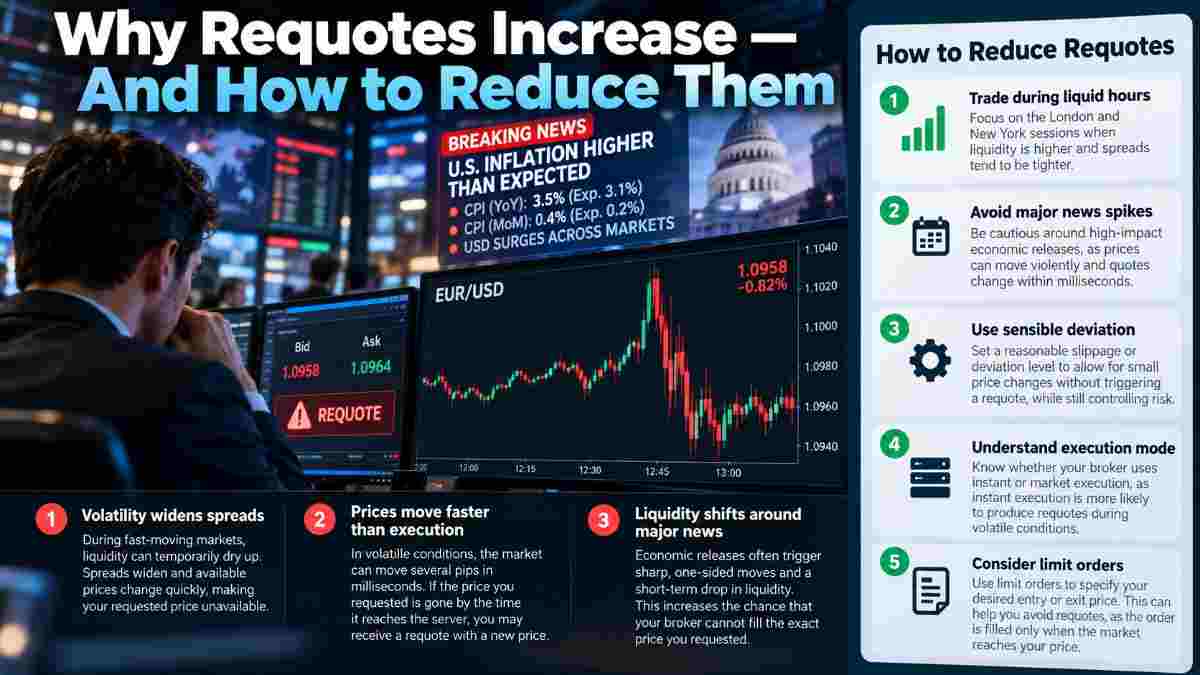
Major economic announcements can create ideal conditions for requotes in forex trading. Inflation releases, employment data and unexpected central-bank decisions can cause currency prices to move several times while an order is still being processed.
At the same time, liquidity providers can update or temporarily reduce the prices they are willing to quote. The spread may widen and the original price can disappear quickly.
A trader using Instant Execution with a very small allowed deviation may therefore experience repeated forex requotes during a volatile event. Increasing the permitted deviation can reduce the frequency of requotes, but it also means accepting a wider range of possible execution prices.
There is no free solution. Greater price tolerance can improve the likelihood of execution while reducing certainty about the exact fill.
Does a Requote Mean a Broker Is Manipulating Prices?
Not necessarily. Requotes are a recognised feature of certain execution modes and are documented directly by trading-platform providers such as MetaTrader.
That does not mean traders should ignore persistent forex execution problems. If one broker consistently produces unusual requotes during otherwise liquid market conditions while comparable platforms do not, execution quality deserves closer investigation.
The important distinction is between an occasional consequence of a changing market and a repeated pattern that materially affects trading. Traders can compare timestamps, price feeds and platform logs when investigating suspicious execution behaviour.
FXReviews’ automated forex trading guide makes a related point: strategies that appear sound before transaction costs can behave differently once execution delay, spread and slippage are included.
Execution should therefore be assessed over a meaningful sample rather than one frustrating trade.
What Is a Broker Requote Policy?
A broker requote policy explains how the broker handles an order when the requested price cannot be accepted. The relevant information may appear in the execution policy, client agreement or platform documentation rather than on a promotional trading page.
Important details include the execution model, allowable deviation, whether price improvement is possible, how orders behave in volatile markets and the circumstances in which an instruction can be rejected.
A trader using an automated strategy should pay particular attention to these rules. An Expert Advisor needs to know how to respond when the server returns a changed price rather than a successful execution.
MetaTrader’s Strategy Tester can even emulate requotes under Instant Execution when simulated price movement exceeds the configured deviation. That reinforces the point that requotes are part of execution logic rather than merely an unexplained broker message.
How to Avoid Requotes in Forex
There is no way to guarantee that forex requotes will never occur while using an execution mode that supports them, but traders can reduce the circumstances in which they become frequent.
Trading during liquid market hours can help because major currency pairs generally have deeper pricing during active sessions than during thin rollover periods. Avoiding market orders immediately around major news releases can also reduce exposure to abrupt price changes.
The deviation setting matters as well. An extremely narrow tolerance increases the chance that even a small movement will require a replacement quote. A wider tolerance increases execution probability but should only be used if the trader understands the possible price difference.
Another option is selecting a broker or account using Market Execution if that execution structure better matches the strategy. This can reduce traditional requotes, but the trade-off is that slippage can still occur.
So how to avoid requotes in forex is not simply about finding a button that switches execution risk off. It is about choosing the appropriate execution model and understanding the compromise between price certainty and fill certainty.
Limit Orders Can Reduce the Need to Chase Prices
Limit orders can also help traders who are unwilling to accept a worse entry beyond a specified level. Instead of repeatedly submitting a market order while the price moves, a trader can define the maximum price they are prepared to pay or the minimum price they will accept when selling.
The trade-off is straightforward: a limit order may not execute at all. If the market moves away without offering sufficient liquidity at the chosen price, the position remains unopened.
This is often preferable for strategies where entry price is more important than immediate participation. For other strategies, missing the trade entirely may be more damaging than accepting some execution movement.
Order choice should therefore reflect the strategy rather than being used solely as a workaround for forex broker requotes.
How Traders Should Review Forex Execution Problems
A single requote tells very little about overall broker quality. A more useful approach is to monitor execution over time and keep the platform journal or trade records when an unusual event occurs.
Look at the requested price, replacement price, timestamp, market conditions and whether comparable price movement was visible elsewhere. Repeated incidents can then be assessed against the broker’s published execution policy.
This also helps distinguish genuine forex execution problems from a strategy that simply demands unrealistic price precision in a rapidly moving market.
A trader should understand how the platform executes an order before increasing trade size. Execution becomes much more important once each pip of difference has a meaningful monetary effect.
Final Thoughts
Forex requotes occur when an execution model requires a specific requested price and that price is no longer accepted by the time the trade reaches the server. Instead of filling automatically at the changed price, the broker returns a replacement quote for the trader to accept or reject.
That makes a requote fundamentally different from slippage and from outright forex order rejection. Slippage changes the eventual fill, while a rejection leaves the requested trade unexecuted.
For traders, the practical issue is not whether every requote is “good” or “bad.” It is whether the broker’s execution process is transparent, consistent with its published policy and suitable for the strategy being used.
Understanding execution mode, allowable deviation and market conditions makes requotes in forex trading considerably easier to interpret when they appear.
Disclosure
This article is for educational and informational purposes only. It is not financial, investment, legal, tax or trading advice. Forex and CFD trading involves substantial risk, while execution prices can be affected by liquidity, volatility, latency and broker methodology. Always review the execution policy applying to your account before trading.
FAQs
What are requotes in forex?
Forex requotes occur when the originally requested execution price is no longer accepted and the broker returns a different price at which the trade can be executed. They are particularly associated with Instant and Request Execution models.
Why do forex orders get requoted?
The most common reason why forex orders get requoted is that the market price changes while the order is being processed. Volatility, low liquidity and a narrow permitted deviation can make this more likely.
What is the difference between requote vs slippage?
In requote vs slippage, a requote asks the trader to accept a new price before execution, while slippage means the trade is executed at a price different from the one expected. Market Execution generally involves slippage rather than traditional requotes.
Are forex broker requotes always suspicious?
No. Forex broker requotes are a recognised part of certain execution models. Frequent or unusual patterns can still justify further investigation, particularly when they differ significantly from prevailing market conditions.
Can market execution have requotes?
Classic Market Execution normally does not use the same requote process because the trader agrees to execution at the available price. However, slippage and order rejection can still occur.
How can traders reduce forex requotes?
Traders can reduce forex requotes by avoiding highly volatile periods, using an appropriate price-deviation setting and choosing an execution model that matches their strategy. None of these measures guarantees a specific execution price.
What is a broker requote policy?
A broker requote policy forms part of the rules describing how the broker handles requested prices, deviations and orders when market prices change before execution.