Automated forex trading has moved from a niche tool used by quantitative desks to something widely discussed by retail traders, broker platforms and signal providers. The appeal is obvious. A system that can scan markets, follow rules and execute trades without hesitation sounds cleaner than manual trading, especially in a market that runs 24 hours a day.
But the reality is more nuanced. Automated forex trading can help remove emotional decision-making, improve consistency and test strategies against historical data. It can also fail quickly when the strategy is poorly designed, over-optimised, badly coded or promoted with unrealistic profit claims.
The Commodity Futures Trading Commission (CFTC) warns that automated trading programs may provide buy or sell signals or execute trades at specific prices, but no technology can consistently predict the future. The same warning is especially relevant today because many promoters now package ordinary forex trading bots as “AI systems” or guaranteed-income tools. The CFTC has separately warned that AI does not turn trading bots into money machines.
For traders, the serious question is not whether automation is good or bad. The better question is whether the system has a logical strategy, reliable execution, controlled risk and a regulated trading environment behind it.
What Is Automated Forex Trading?
Automated forex trading is the use of software to analyse currency markets and place trades according to pre-set rules. Those rules may be simple, such as buying EUR/USD when a moving average crosses above another moving average. They may also be more advanced, using volatility filters, price-action conditions, economic-event restrictions or multiple indicators.
In basic terms, automated forex trading systems follow instructions. They do not “feel” fear after a losing trade and they do not become greedy after a winning streak. That is the attraction. A trader can define an entry, exit, stop-loss, take-profit and position-size rule, then allow automated forex trading software to execute the plan.
Still, automation does not remove market risk. It only changes how the trade is executed. A bad rule followed perfectly is still a bad rule. A system that worked during one market condition may underperform when volatility, spreads or central-bank expectations change.
This is why forex automation should be treated as a trading process, not a shortcut. It requires testing, monitoring and regular review.
How Automated Forex Trading Works
Most automated forex trading setups follow the same broad chain: market data comes in, the system analyses the data, a trade signal is generated, risk rules are checked, and an order is sent to the broker.
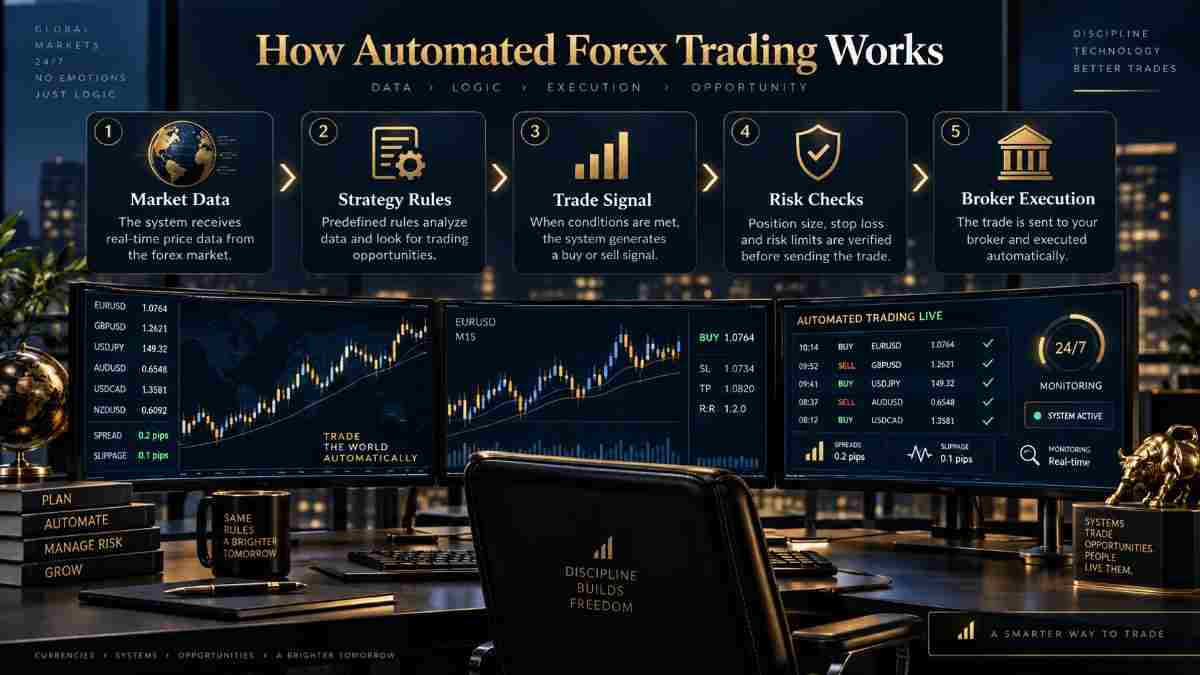
The trading logic may run on a desktop platform, cloud server, virtual private server or broker-supported environment. MetaTrader describes Expert Advisors as mechanical trading systems that can automate analytical and trading activity, while MetaTrader 5 supports algorithmic trading through MQL5, MetaEditor and a Strategy Tester. cTrader also supports cBots, which are automated programs designed to perform trading operations based on their code and settings.
That sounds technical, but traders should keep one practical point in mind: execution quality matters. A strategy may look profitable in a backtest but behave differently when spreads widen, slippage appears or an order is filled at a worse price than expected.
For readers comparing broker conditions, FXReviews’ low spread brokers guide is relevant because automated strategies can be highly sensitive to spread and transaction cost. Scalping systems, in particular, can look attractive before costs and much weaker after real trading friction.
Automated Forex Trading Systems and Execution Logic
Automated forex trading systems usually fall into two groups. The first group is rule-based. These systems use fixed logic, such as trend-following, breakout, mean-reversion or volatility filters. The second group is more adaptive, often marketed around data models, machine learning or AI-style optimisation.
Rule-based systems are easier to inspect. Traders can understand why the system enters and exits. More complex systems may be harder to audit, especially when the developer does not clearly explain the decision logic. That is where many retail traders get into trouble. They buy a bot because the equity curve looks smooth, not because they understand how the strategy behaves under stress.
Good automated forex trading systems should include risk controls before trade execution. That means maximum lot size, maximum daily loss, stop-loss logic, spread filters, trading-session filters and rules for high-impact news events. Without those controls, forex trading bots can become dangerous during sudden volatility.
Common Automated Forex Strategies
Automated forex strategies usually begin with a market condition. Trend-following systems try to capture extended directional moves. Breakout systems look for price to move beyond a defined range. Mean-reversion systems assume that price has moved too far from an average and may return. News-avoidance systems do not trade during major events because spreads and slippage can rise.
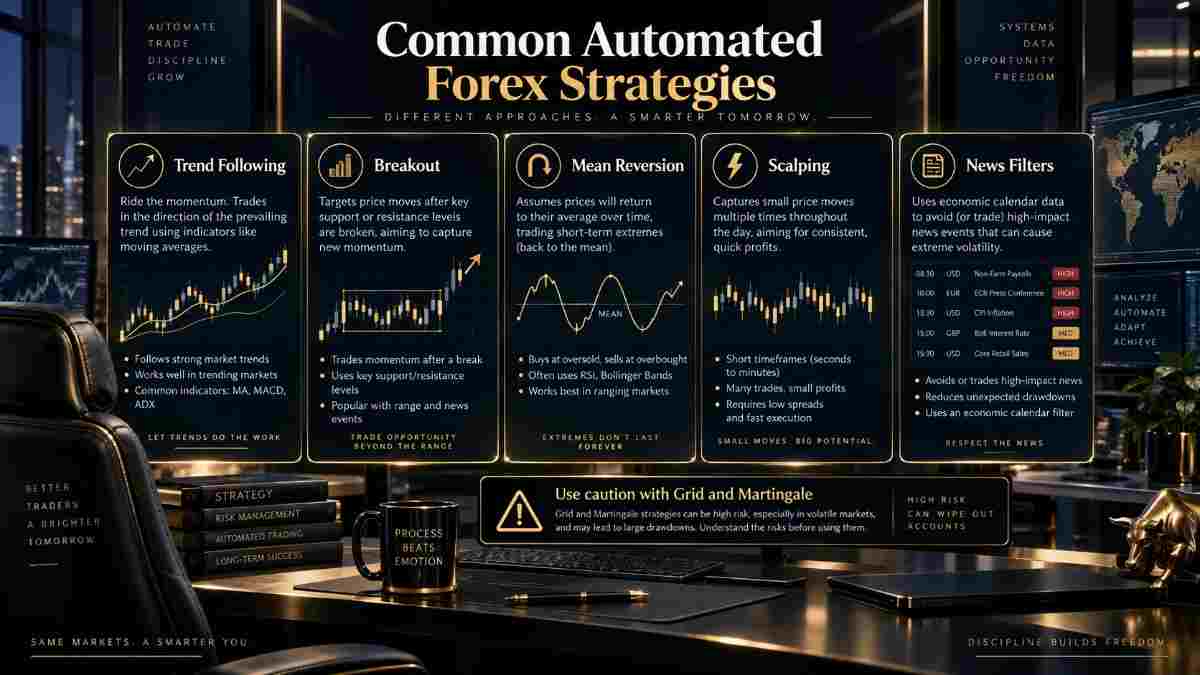
Scalping is also common in forex automation, but it is not easy. A scalping bot may target small price moves, so spread, commission, latency and execution speed become critical. A few bad fills can damage the system’s edge.
Grid and martingale-style automated forex strategies are popular online, but traders should be cautious. These systems may show steady small gains until a strong trend creates large floating losses. Any strategy that increases trade size after losses can become account-threatening if the market keeps moving in one direction.
Algorithmic forex trading works best when the trader understands both the strategy and the market regime. A trend system may struggle in a choppy range. A mean-reversion system may suffer during a strong central-bank-driven move. Automation can execute faster than a human, but it cannot make a weak strategy safe.
Best Tools for Automated Forex Trading
The best tools for automated forex trading depend on the trader’s skill level, broker access and strategy type. There is no single tool that is best for everyone.
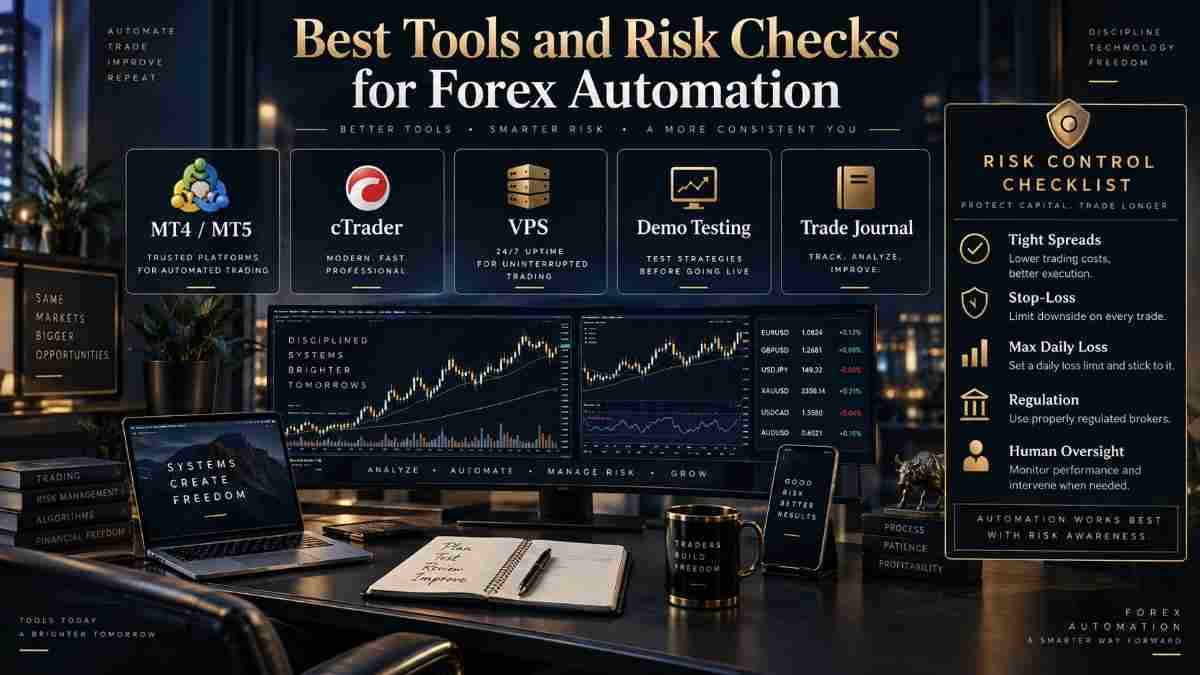
For many retail traders, MetaTrader 4 and MetaTrader 5 remain common choices because of Expert Advisors, backtesting tools and a large marketplace for indicators and trading robots. cTrader is another serious option for traders who want cBots and algorithmic execution. TradingView is useful for charting, alerts and strategy testing, although traders should check the platform’s current broker-execution limitations before assuming full automation is available.
Automated forex trading software should also be supported by practical infrastructure. A VPS can reduce the risk of a home internet outage. A demo account can help forward-test the bot in live market conditions without risking real capital. Trade journals and analytics tools can reveal whether performance is coming from a real edge or simply from favourable market conditions.
FXReviews’ broker review section can help traders compare broker platforms, spreads, account conditions and trading features before choosing where to run automated forex trading. Its Why Trust Us page also explains the site’s approach to broker reviews and trading research.
Automated Forex Trading Software Needs Human Oversight
Automated forex trading software should never be left completely unmanaged. Even a stable system can malfunction if the broker changes symbols, spreads widen, the platform disconnects or market conditions shift sharply.
Human oversight matters most during central-bank decisions, inflation releases, employment data and geopolitical shocks. These events can move forex pairs quickly and widen the gap between backtested assumptions and live execution.
This is also why forex automation needs a stop point. A trader should know when to pause the bot, when to reduce lot size and when to stop trading entirely. The system should not be judged only by profit. Drawdown, recovery time, average loss, win/loss distribution and exposure during news events matter just as much.
Risks of Forex Trading Bots
Forex trading bots often become risky when they are sold with unrealistic claims. Be careful with phrases such as “guaranteed profit,” “no loss,” “daily income,” or “works in all market conditions.” Those are marketing signals, not evidence.
The FCA says CFDs are high-risk products and are not suitable for all retail consumers. It also warns consumers to check a firm’s regulatory status before trading CFDs or rolling spot forex. The CFTC similarly advises traders to verify registration and background information before working with any person or firm offering forex, derivatives or commodity-related trading services.
This matters because algorithmic forex trading is often promoted by third-party vendors, not always by regulated brokers. A bot seller may show screenshots, but traders need to ask harder questions: Is the performance audited? Are results live or hypothetical? Are trading costs included? What is the maximum historical drawdown? What happens during news spikes? Can the system be tested before purchase?
FXReviews’ HighMarkets review and FXRoad review show why broker features such as leverage, platform quality, risk warnings and execution conditions should be reviewed before trading any automated setup.
Practical Checklist Before Using Forex Automation
Before using automated forex trading, start with the strategy. It should be simple enough to explain in plain language. If the system cannot explain why it trades, the trader is relying on trust rather than analysis.
Next, test it. Backtesting is useful, but it is not enough. Historical data can hide spread changes, slippage and execution delays. Forward-testing on a demo account gives a better sense of how automated forex strategies behave in live market conditions.
Then check the broker. A bot that depends on tight spreads should not be run on an account with wide or unstable pricing. A system that trades frequently should be evaluated after commission and swap costs. If the broker is not properly regulated or does not clearly disclose trading conditions, the automation risk increases.
Finally, limit exposure. Use smaller position sizes first. Set maximum loss limits. Monitor the system daily. Do not increase capital just because the first few trades are profitable.
Final Thoughts on Automated Forex Trading
Automated forex trading can be useful when it supports a disciplined strategy, not when it replaces judgment. The strongest systems are built around clear rules, realistic testing, controlled leverage and broker conditions that match the strategy.
Forex automation is not a promise of passive income. It is a technical way to execute trading logic. Automated forex trading systems can help remove hesitation and improve consistency, but they can also magnify mistakes faster than manual trading.
For serious traders, the balanced approach is best: use automated forex trading software carefully, understand the strategy, verify the broker, test before scaling, and treat every performance claim with caution. The tool can help, but the risk still belongs to the trader.
Disclosure
This article is for educational and informational purposes only. It is not financial, investment, legal, tax, or trading advice. Crypto and financial markets are volatile and can lead to capital loss. Always verify information from official sources before making financial decisions.
FAQs
What is automated forex trading?
Automated forex trading uses software to analyse currency markets and place trades based on pre-set rules. It can help with discipline and execution, but it does not remove market risk.
Are automated forex trading systems safe?
Automated forex trading systems can be useful if they are tested, monitored and supported by proper risk controls. They are not automatically safe, especially if they use high leverage, martingale logic or unrealistic profit targets.
What is the best automated forex trading software?
The best automated forex trading software depends on your broker, strategy and technical ability. MetaTrader Expert Advisors, cTrader cBots and TradingView-based alert systems are common tools, but none guarantees profit.
Are forex trading bots profitable?
Some forex trading bots may perform well in certain conditions, but performance can change when spreads, volatility and market trends shift. Be cautious with any bot that promises guaranteed returns.
What is algorithmic forex trading?
Algorithmic forex trading means using programmed rules to generate and execute forex trades. The rules may be based on indicators, price action, volatility, time filters or more complex models.
What are common automated forex strategies?
Common automated forex strategies include trend-following, breakout trading, mean reversion, scalping and news-filtered systems. Each strategy has different risks and should be tested before live trading.