
Forex trading may appear to be confusing because of terms like currency pairs, pips, spread, leverage, and lots. However, the underlying principle of forex trading is quite straightforward. All that is required for forex trading is buying one currency while selling another simultaneously. How do forex transactions work in practice? Here is a guide on how forex trading works.
What Is Forex Trading?
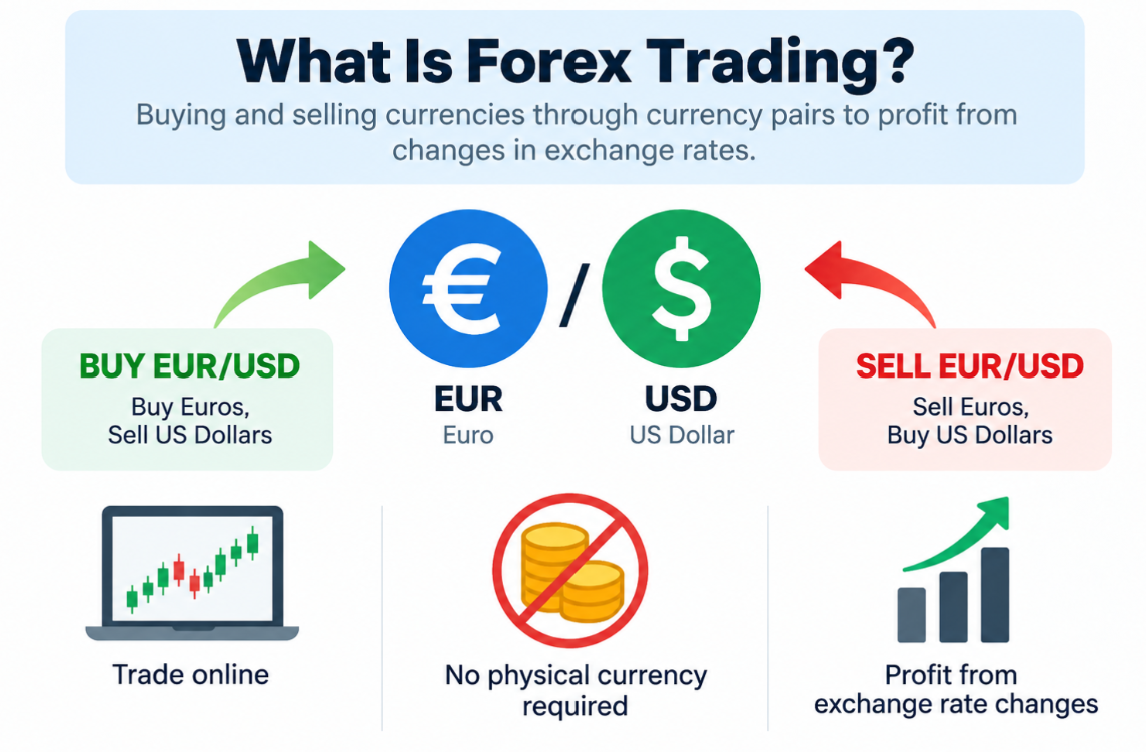
Prior to finding out how does forex trading work, it is necessary to define what is forex trading. Forex trading is the process of buying and selling currencies on the market. However, unlike conventional stock exchange, forex trading is performed via currency pairs.
For instance, when talking about EUR/USD, we compare the euro with the US dollar. When purchasing EUR/USD, one buys euros and sells US dollars, while when selling EUR/USD, one sells euros and buys US dollars. Traders can also refer to CME Group’s guide to FX quote conventions to better understand how currency pairs are quoted.
This is a brief definition of forex trading given in simple words. In forex trading, traders try to make profits based on fluctuations in the exchange rate between two currencies.
What is forex trading in simple words also involves realization that traders usually do not receive any physical currency when making a trade.
How Does Forex Trading Work?
How then does forex trading work? How does one engage in the forex market? Forex trading occurs when a person chooses a currency pair to trade on and determines that its price may either rise or drop.
Each currency pair has a bid price and an ask price. The distance between the bid and ask prices is referred to as the spread. Once the person makes a trade, the transaction takes place at the prevailing market price.
To illustrate further, consider a case where the EUR/USD is priced at 1.1000. The trader thinks that the euro will strengthen against the US dollar and he purchases the pair. In case the price increases to 1.1050, he can close the trade in profit.
Otherwise, if the price drops, then the trader suffers a loss.
This is the most simplified form of how does forex trading work, but there is more to forex trading than that.
How Forex Trading Works for Beginners
The knowledge of how forex trading works for beginners begins with understanding several key terms. In a currency pair, there are two currencies. The first currency is the base currency and the other one is the quote currency.
The exchange rate indicates how many units of the quote currency are required to buy one unit of the base currency.
To understand how forex trading works for beginners, an example can make things clearer. Assuming the EUR/USD exchange rate is 1.1000, then it means that one euro costs 1.10 US dollars.
If a trader believes that EUR/USD will rise, he/she buys it. On the other hand, if he/she believes that it will fall, he/she sells it.
This is an essential aspect of how forex trading works for beginners, since a trader can trade either way. However, predicting the movement of currencies is not easy.
Forex Market Basics
It is necessary to understand the forex market basics before making any trades. The forex market is a global one that involves banks, financial organizations, firms, investors, and individual traders.
The forex market basics are related to the fact that this market works in the major financial centers and is available on business days. The trading volume may differ according to the market session and economic events.
Moreover, forex market basics involve major currency pairs, minor currency pairs, and exotic currency pairs. Major pairs consist of such currencies as US dollar, euro, British pound, Japanese yen, Swiss franc, Canadian dollar, Australian dollar, and New Zealand dollar.
Understanding the forex market basics helps beginners to realize why some currency pairs trade more actively than other pairs.
How to Trade Currency Pairs
To learn how to trade currency pairs, one needs to know whether he/she wants to buy or sell a certain pair.
For instance, if you expect that the British pound will rise against the US dollar, then buying GBP/USD can be considered. On the other hand, if you feel that the pound will fall against the dollar, you may think about selling GBP/USD.
In short, the above is a general overview on how to trade currency pairs. However, traders normally do some analysis before executing a trade.
Technical analysis involves use of graphs, prices, and indicators. In fundamental analysis, things like inflation, interest rates, employment data and economic growth are analyzed.
When learning how to trade currency pairs, people should also know about position size and risk. A big position can make one make big profits but also big losses.
Forex Trading Explained: Pips, Lots and Spreads
A key part of forex trading explained is understanding pips. A pip is a common unit used to describe small changes in a currency pair’s exchange rate.
For many currency pairs, one pip is equal to the fourth decimal place. However, there are exceptions, particularly for currency pairs involving the Japanese yen.
Another part of forex trading explained is the concept of a lot. A lot refers to the size of a forex position. Brokers may offer different position sizes, including standard, mini, and micro lots.
The spread is another important term. It represents the difference between the bid and ask prices.
Understanding these concepts makes forex trading explained much easier for someone who is completely new to the market.
Forex Trading Examples
Simple forex trading examples can make the process easier to understand.
Imagine EUR/USD is priced at 1.1000. You believe the euro will strengthen and buy the pair. Later, EUR/USD moves to 1.1050. If you close the trade at that price, the movement in your favour could create a profit, excluding trading costs. For more information on forex brokers and trading conditions, readers can also explore FX Reviews Best.
Now consider another example. You buy GBP/USD because you expect the pound to rise. Instead, the price falls. If you close your position at a lower price, you may have a loss.
These forex trading examples show why market direction matters.
Other forex trading examples could include selling a currency pair when you expect its price to fall. However, short selling does not guarantee a profit and carries significant risk.
Using forex trading examples while learning can help beginners understand how price movements affect their trading accounts.
How to Make Money Trading Forex
The most frequently asked question by new traders is what would be the way of making money trading forex. The answer is very simple: traders aim at buying low and selling high or selling high and buying low later.
Unfortunately, there is no guaranteed formula of how to make money trading forex.
Trading demands knowledge of market conditions, risk management, cost of trading, and personal discipline. Traders may apply different methods of analysis, such as technical and fundamental, to find possible opportunities.
If a trader thinks about how to make money trading forex, then he/she should pay attention not only to the ways of making money but also to the loss management.
Traders who take big risks all the time will eventually lose money regardless of several successes. Thus, the learning of how to make money trading forex must imply learning risk management.
How Does Forex Trading Work With Leverage?
Another essential aspect relating to how does forex trading work is leverage. Leverage means that the trader controls a position which is larger than the deposit in the trading account, depending on the terms offered by the broker.
In other words, with leverage, the trader can open a position which is larger than the trader’s cash balance allows.
Nevertheless, leverage increases both possible gains and losses. That is why newbies should be cautious while working with leverage.
Not knowing how does forex trading work and not taking into account the aspect of leverage, novice traders will not be ready for the rate of increasing losses.
How Forex Trading Works for Beginners: A Simple Process
The process of how forex trading works for beginners can be divided into a few simple stages.
First, choose a suitable and properly regulated broker available in your jurisdiction. Check its fees, trading conditions, available currency pairs, and withdrawal rules.
Second, open and verify your trading account. Brokers commonly require identity and other information as part of their onboarding process.
Third, learn forex market basics and practise using a demo account if one is available.
Fourth, select a currency pair and analyse the market.
Fifth, decide the position size and place an order.
Finally, monitor the position and close it according to your trading plan.
This process gives beginners a practical understanding of how forex trading works for beginners without making the process seem unnecessarily complicated.
Understanding Currency Prices
Currency prices can change for many reasons. Interest-rate decisions, inflation, employment figures, economic growth, political developments, and market sentiment can all influence exchange rates.
For example, if investors expect a country’s central bank to raise interest rates, demand for its currency may change. Similarly, unexpected economic news can cause rapid price movements.
This is why forex trading explained should not focus only on charts. Economic information can also have a major effect on currency markets.
Traders who understand forex market basics can use economic calendars and market news to keep track of important events.
Common Mistakes Beginners Should Avoid
Knowing how does forex trading work is only the first step. Beginners should also understand common mistakes.
One mistake is trading without a plan. Another is risking too much money on a single position. Some beginners also use excessive leverage because they focus only on potential profits.
Trying to recover losses quickly can lead to even bigger losses.
When learning how to trade currency pairs, beginners should focus on understanding the market instead of trying to make quick money.
Similarly, the question of how to make money trading forex should not encourage unrealistic expectations. Forex trading involves risk, and past performance does not guarantee future results.
Final Thoughts
How forex trading works will be much clearer if the process is divided into steps. In forex, traders can trade against each other by exchanging one currency for another using currency pairs. Currency pairs can either be bought or sold according to traders’ predictions.
In forex trading for beginners, there are several things one needs to learn including currency pairs, pips, spreads, lots, leverage, orders, and risk management. This forex trading made easy guide is meant to give beginners an insight into the basics of forex trading.
The basic principles of forex trading are quite straightforward, although discipline comes from hard work and practice. Forex trading examples will give a hint on how much profit or loss one can make, while how to trade currency pairs will shed light on how positions are opened and closed.
Finally, one looking into how to make money forex trading must understand that there is no strategy that guarantees success.
FAQs
1. What is forex trading?
Forex trading is the buying and selling of currencies through currency pairs to potentially benefit from changes in exchange rates.
2. How does forex trading work for beginners?
Beginners choose a currency pair, analyse the market, decide whether to buy or sell, select a position size, and manage the trade.
3. How do currency pairs work?
A currency pair compares the value of one currency against another. The first currency is the base currency and the second is the quote currency.
4. Can you make money trading forex?
It is possible to make profits, but forex trading also involves significant risk. There is no guaranteed method of making money.
5. Is forex trading risky?
Yes. Currency prices can change quickly, and leverage can increase both potential profits and losses. Beginners should understand the risks before trading with real money.