
In case you are starting out with forex, there is one term that catches out a lot of people, namely lot size. It is something that your broker determines before you even make your first trade in terms of minimum trade size in forex broker. In case you do not understand what this is about, or choose a broker with wrong lot size requirements, you may find yourself putting at stake much more funds than intended.
The current article explains everything there is to know about minimum trade size and how to choose a broker with proper lot size rules.
What Is Forex Broker Minimum Trade Size?
In simple terms, forex minimum trade size is the smallest amount of positions that a broker will allow you to open. Currencies cannot be traded in units; they are traded in terms of “lots”. Standard lots refer to 100,000 units of the base currency while a mini lot refers to 10,000 units and a micro lot refers to 1,000 units. There are also some brokers who offer nano lots which consist of 100 units.
Different brokers allow different amounts of minimum trade sizes for forex traders and there may be a great deal of difference between different platforms. The minimum trade size that a broker allows might range from full standard lots to micro and nano lots. This is an important factor which is more significant than most traders would realize initially.
Why Forex Minimum Lot Size Matters
The forex minimum lot size a broker allows directly affects how much money you need to trade safely. If a broker only permits standard lots, you’d need a much larger account to trade responsibly, because each pip of movement on a standard lot is worth roughly $10 for many USD-quoted pairs. That kind of movement can have a significant impact on a small account. Traders can also explore FX Reviews Best for additional forex broker information and reviews.
On the other hand, a broker offering micro or nano lots lets you control your risk far more precisely. Instead of risking $10 a pip, you might risk $1 or even $0.10 a pip. This is exactly why the minimum lot forex broker rules you choose to trade under can make or break your experience as a beginner.
How Minimum Lot Size Affects Small Accounts
If you’re trading with a small account say, a few hundred dollars the smallest forex trade size available to you becomes one of the most important factors in choosing a broker. A broker that forces you into standard lots could mean a single trade represents a huge percentage of your account balance, which is a fast track to blowing it up.
Brokers that support micro or nano lots let traders with modest capital still practice proper risk management. This is one of the biggest reasons beginners are advised to look closely at the forex broker lot size options before opening an account, rather than picking a broker based on spreads or bonuses alone.
Standard, Mini, Micro and Nano Lots Explained
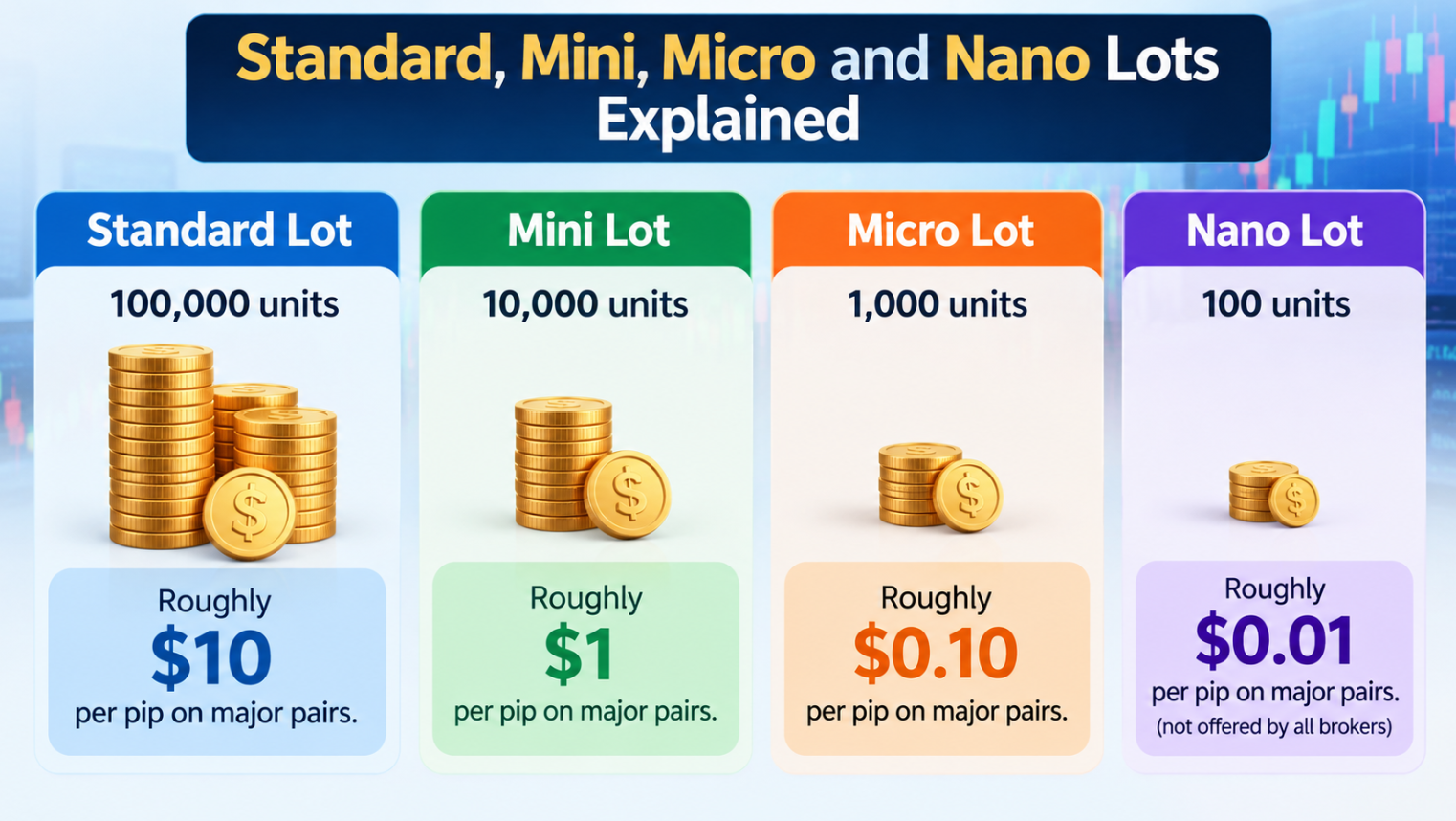
Understanding the different lot sizes helps put the whole idea of minimum position size forex brokers offer into context:
- Standard lot – 100,000 units. Roughly $10 per pip on major pairs.
- Mini lot – 10,000 units. Roughly $1 per pip.
- Micro lot – 1,000 units. Roughly $0.10 per pip.
- Nano lot – 100 units. Roughly $0.01 per pip (not offered by all brokers).
Most retail brokers today support at least micro lots, but not all of them do and the ones that don’t can be a poor fit for anyone without a fairly large account. Knowing your broker’s forex trading lot size options before you fund an account can save you a lot of frustration later.
How Minimum Trade Size Affects Risk Management
Risk management in forex trading involves controlling the maximum potential loss on each trade. Position size is one part of this process, while stop-loss distance is another. If your broker’s minimum position size is large compared with your account, you may have less flexibility to control risk and could end up risking more per trade than intended. Traders can also explore BabyPips for additional forex education and risk-management resources.
It is here that the minimum trade size for forex brokers becomes a true form of risk management. Those traders who are able to trade at smaller lot sizes can manage their positions such that the risk taken on each trade is only a small percentage of their account typically 1-2% per trade.
Choosing a Broker Based on Lot Size
When choosing among different brokers, one should not be tempted to assume that brokers all have similar forex broker lot size policies and thus should check them individually. Points to look for:
- Does the broker provide micro and nano lots, or just mini and standard lots?
- What are the stated forex broker minimum trade sizes in account terms?
- Are there any differences in lot requirements depending on the type of an account (standard, ECN, Islamic, and others)?
- Can you control your position size incrementally or in fixed lots on your trading platform?
Brokers that target beginner and retail traders usually offer the smallest lot sizes because it is the very thing that novice traders require. On the other hand, brokers catering to institutions and heavy volume traders often have higher forex broker minimum lot requirements.
Why Some Brokers Restrict Minimum Lot Size
Not every broker offers tiny lot sizes, and there are a few reasons for that. Some brokers operate on business models that are more efficient at higher trade volumes, so they set a higher minimum lot size to match. Others may simply not have updated their platform to support micro or nano-level trading. Regulatory environment can play a role too, since certain jurisdictions have different standard practices around minimum position size forex accounts are allowed to hold.
Whatever the reason, it’s worth checking this detail directly rather than assuming every broker works the same way the smallest forex trade size offered can differ significantly even between brokers that otherwise look similar on the surface.
Demo Accounts and Lot Size Practice
Before committing real money, it’s worth using a demo account to get a feel for how forex trading lot size affects your account balance in practice. Most demo accounts mirror the live platform’s lot rules, so you can test how a micro lot trade moves your balance compared to a mini or standard lot. This hands-on practice tends to make the concept click far faster than reading about it, and it lets you compare how different position sizes behave before you’re risking actual funds.
Common Mistakes Traders Make With Lot Size
A lot of beginner mistakes trace back to misunderstanding minimum trade size. Some common ones include:
- Opening an account without checking lot size rules first, then realizing the minimum position size forex the broker requires is too large for a small account.
- Confusing lot size with leverage, when the two are actually separate settings that interact with each other.
- Trading standard lots on a small account because a broker doesn’t clearly display micro lot options.
- Not adjusting position size relative to stop-loss distance, which defeats the purpose of having access to smaller lots in the first place.
Avoiding these mistakes usually just comes down to checking a broker’s lot size policy carefully before opening a live account, rather than after.
Final Thoughts
The lot size minimum allowed by the forex broker will affect just about everything that you do in terms of trading including your level of risk per trade, your required capital, and your ability to control your account effectively. Small-account traders will need to ensure that their brokers allow micro and nano lots in order to be able to risk manage properly. Bigger or more experienced traders will not have to bother too much with this information, but it is still a good idea to make sure that you know the minimum lot requirements of your broker.
Before opening an account, ensure that you know the lot sizes allowed by the broker, try them out on the demo account and verify that the minimum lot size allowed by the forex broker is indeed equal to your trading account size.
Frequently Asked Questions
What is the smallest trade size in forex?
This varies from one broker to another. However, most retail brokers allow traders to trade at least a micro lot (1,000 units), and some may even go as low as allowing a nano lot (100 units). Some brokers only allow mini or standard lots; therefore, one needs to confirm this.
What is a micro lot in forex?
A micro lot in forex is 1,000 units of the base currency, amounting to about $0.10 pip movement in the main currency pairs. This is the most common minimum lot that is provided by brokers.
Why do some brokers not allow anything less than a standard lot?
Some brokers have been established with bigger trading sizes in mind.
Is minimum lot size related to leverage?
No, not directly, but both are interrelated. Leverage will determine the amount of capital required for opening a position, while lot size will determine the actual size of the position. Both should be taken into consideration when taking risks.
Where can I find a broker with minimum trade size?
The terms and conditions section or trading conditions section on the website of the broker will specify the lot sizes offered by the broker. You may also want to try it out yourself with the help of a demo account.