
Opening a forex trade does not always mean you have complete control over when it will eventually be closed. Under certain circumstances, the broker’s trading system can liquidate an open position automatically without asking for approval at that moment. So, can a forex broker close position without first contacting the trader? Yes. Margin rules are the most common reason, but they are not the only one.
A forced position closure may occur when account equity falls below the broker’s stop-out threshold, when a product expires, when regulatory or market restrictions require action, or in circumstances specifically covered by the broker’s client agreement.
For leveraged traders, understanding these rules before opening a position is essential because liquidation can happen precisely when the account is already under significant pressure.
When Can a Forex Broker Close Position Automatically?
The most common situation in which a forex broker close position process occurs is insufficient margin. Leveraged trading allows a client to control a position larger than the cash deposited as margin. If the trade moves against the client, unrealised losses reduce account equity.

Eventually, the margin level can reach the broker’s stop out threshold. At that point, the broker’s system can begin closing positions to reduce exposure.
In UK retail CFD accounts, the FCA’s current margin rules require a firm to ensure that a retail client’s net equity does not fall below 50% of the margin required to maintain relevant open positions. If equity falls below that threshold, the firm must close positions as soon as market conditions allow.
This is not treated as an optional request from the trader. It is part of the account’s risk framework.
Broker Closes Trade Because of Margin: A Simple Example
Suppose a trader deposits $2,000 and opens leveraged positions that require $1,600 of margin. As the market moves against those positions, equity falls. If the applicable liquidation rule is triggered when equity falls to a particular percentage of required margin, the broker may start closing trades once that threshold is crossed.
When the broker closes trade automatically, the trader does not normally need to press a confirmation button. The purpose is to reduce the account’s exposure before losses develop further.
The exact threshold is not universal. FXReviews broker pages demonstrate why traders need to check individual account conditions. For example, the site’s CapPlace review identifies the stop-out condition published for that broker’s account structure, while the SmartSTP review discusses margin and leverage within its account conditions.
These broker-specific terms can differ substantially from FCA-regulated retail CFD rules.
What Is a Forced Position Closure?
A forced position closure is an exit initiated under the broker’s risk, contractual or regulatory rules rather than through a new manual close instruction from the trader. Margin liquidation is the best-known example.
However, a position may also be closed because the underlying product is expiring, the instrument has been discontinued, trading conditions have materially changed or the broker is acting under specific contractual rights. This is why traders should read more than the spread table before opening an account.
The broker’s legal documentation may explain rights relating to abnormal markets, pricing errors, prohibited trading practices, corporate events, account restrictions or termination. A forex broker close position clause should therefore be read in context. Some closures are automated risk events; others depend on contractual circumstances.
What Is Forex Position Liquidation?
Forex position liquidation means closing an open leveraged position, usually because the account can no longer support the required margin.
In retail CFD markets, liquidation rules can operate on an account basis rather than considering each trade independently.
The FCA rule for relevant UK retail accounts requires closure once account net equity falls below 50% of the margin needed to maintain open restricted speculative positions.
European rules established by ESMA use a similar account-level 50% margin close-out framework for retail CFDs.
Importantly, the rules do not necessarily prescribe that every broker must close exactly the same trade first. A broker may close one position, several positions or enough exposure to restore the required margin relationship, depending on its policy and applicable regulation. That makes the broker liquidation sequence worth checking before trading.
Stop Out vs Margin Call
A stop out and a margin call are related but different. A margin call is generally a warning that account equity or usable margin has deteriorated. A stop-out is the threshold at which liquidation can begin.
Consider the following simplified sequence:
| Account condition | Typical outcome |
| Healthy margin level | Positions remain open |
| Free margin declines | Trader has less capacity for adverse movement |
| Margin warning/call | Broker may warn the trader |
| Stop-out threshold reached | Automatic liquidation can begin |
A trader should not assume that a forex broker close position event will always be preceded by a telephone call or enough time to deposit additional money.
Markets can move extremely quickly.
The FCA requires relevant firms to close retail positions as soon as market conditions allow after the regulatory margin threshold is breached. It does not require the broker to wait indefinitely for the client to respond.
Can a Broker Close a Trade Even If It Has a Stop-Loss?
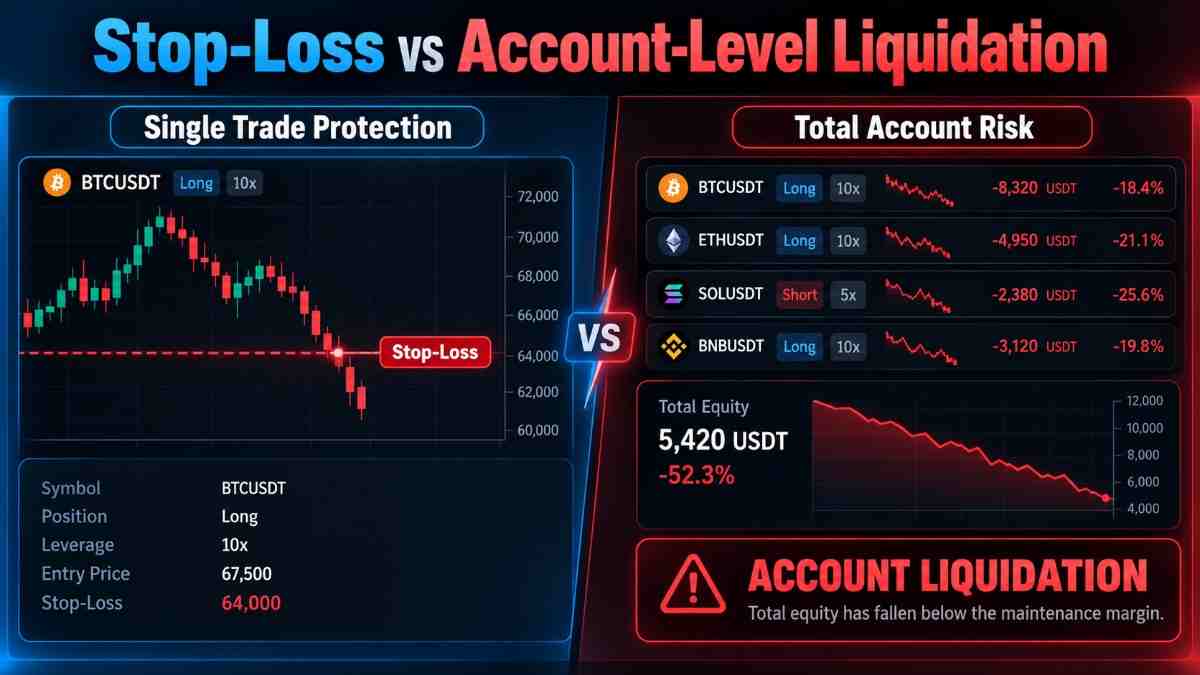
A stop-loss is a trader’s instruction to exit if price reaches a specified level. Margin liquidation operates at the account level.
These two mechanisms are not the same. ESMA has specifically explained that a position with a guaranteed stop can still be closed earlier if account-level margin close-out requirements are triggered.
For example, a trader may have several leveraged positions. One individual trade might still be some distance from its stop-loss, but losses elsewhere in the account can pull total equity below the required margin level.
The broker may then liquidate positions before that individual stop is reached.
This is why traders should manage total account exposure, not merely place a stop-loss on each trade and assume liquidation becomes impossible.
Which Position Does the Broker Close First?
When broker liquidation begins, the position-closing sequence depends on the broker’s platform, account rules and applicable regulation.
One system may close the largest losing position first. Another may close trades based on margin consumption. A broker can also close more than one position if reducing a single trade is insufficient.
ESMA’s retail CFD framework establishes when margin close-out must occur but does not prescribe one universal order in which every position must be liquidated.
That makes the broker’s own margin policy important.
Before trading with high leverage, look for terms such as:
- Margin close-out
- Stop-out
- Automatic liquidation
- Margin level
- Liquidation sequence
- Close-out percentage
The FXRoad review on FXReviews also shows why platform controls and margin conditions should be reviewed alongside leverage rather than separately.
Can a Forex Broker Close Position Because a Contract Expires?
Yes, depending on the product.
Spot-style rolling forex CFDs may remain open while margin and financing conditions are met, but other CFDs can have expiry dates.
A futures-based oil, index or other derivative CFD can be closed or rolled according to the broker’s contract specifications.
This is not usually the same as forex position liquidation caused by insufficient margin. It is a product lifecycle event.
The instrument specification or trading conditions should state whether the contract expires, whether the broker automatically rolls it into a new contract and whether open positions are closed at a particular time.
Never assume every instrument on a forex broker’s platform works like a rolling currency pair.
Can the Broker Close Positions During Extreme Market Conditions?
Broker agreements commonly contain provisions covering abnormal market conditions. These can include market closure, lack of liquidity, suspension of an underlying asset, exchange action or extraordinary volatility.
A broker cannot manufacture liquidity where none exists. If an instrument becomes unavailable or the underlying market suspends trading, normal execution may become impossible.
When execution becomes possible again, the available market price may differ materially from the previous quote.
The exact rights of the broker depend on its agreement and applicable law.
This is another situation where asking only “Can a forex broker close position?” is not enough. The trader also needs to know the circumstances and pricing methodology under which a forced closure can occur.
Can a Broker Close Your Account and Your Trades?
The client agreement may permit account termination or restrictions after events such as regulatory requirements, failed identity verification, prohibited behaviour, suspected fraud or serious breaches of account terms. That does not mean brokers can arbitrarily confiscate profitable positions whenever they choose.
Regulated firms remain subject to applicable conduct rules and contractual obligations. For example, FCA rules remind firms that client best-interest and best-execution obligations remain relevant when firms exercise discretionary rights to close a retail client’s position.
If a broker closes trades for a reason that appears inconsistent with its published terms, the trader should request a written explanation and relevant execution records.
What Is the Difference Between Broker Liquidation and Negative Balance Protection?
Broker liquidation attempts to reduce exposure before account losses become more severe. Negative balance protection addresses what happens if liquidation cannot prevent the account from moving below zero.
Under current FCA rules for relevant retail speculative products, client liability is limited to the funds in the protected trading account. That protection does not mean liquidation waits until the balance reaches zero.
A broker can and, under the applicable UK retail CFD framework, must begin closing positions earlier at the prescribed margin level.
These mechanisms work together:
Margin deterioration → stop out → forex position liquidation → negative balance protection if necessary
The aim is to contain leveraged losses, not guarantee that the trader retains part of the original deposit.
How to Reduce the Risk of Forced Position Closure
The most effective way to reduce forced position closure risk is to avoid operating close to the broker’s liquidation threshold. Use smaller positions and maintain adequate free margin.
Remember that several positions can behave like one large exposure. Being long EUR/USD and GBP/USD at the same time, for example, can create concentrated exposure to a weaker U.S. dollar. Check margin requirements before major economic announcements because volatility can rise abruptly.
Do not rely on a last-minute deposit to save an account. Payment processing can take time, while markets can move in seconds. Most importantly, know the broker’s stop out percentage before opening leveraged trades.
What to Do If a Broker Closes Trade Unexpectedly
If a broker closes trade and you do not understand why, begin with the account history. Check margin level, equity, timestamps and execution prices.
Then read the margin and liquidation sections of the broker’s terms. If the numbers do not appear consistent, contact support and request a detailed explanation. Keep screenshots, transaction IDs and platform records.
If the broker is regulated and the dispute cannot be resolved directly, the relevant regulator or dispute-resolution mechanism may provide information on the next steps, depending on jurisdiction.
Do not assume that every unexpected closure is misconduct—but do not assume that every closure is correct either. Evidence matters.
Final Thoughts
Can a forex broker close position without asking first? Yes, particularly when margin falls below the account’s required liquidation level. A forced position closure is a normal part of leveraged risk management when stop-out conditions are reached. Other closures can arise from product expiry, unusual market conditions or contractual account events. The practical protection is preparation.
Read the margin policy, understand the stop out threshold, know how the broker calculates margin level and avoid running the account so close to liquidation that a modest price movement transfers control of the exit from you to the broker. Once the liquidation threshold is reached, closing the trade may no longer be your decision.
Disclosure
This article is for educational and informational purposes only. It is not financial, investment, legal, tax or trading advice. Forex and CFD trading involves substantial risk, particularly when leverage is used. Margin and liquidation rules vary by broker, jurisdiction and account type. Always review the applicable client agreement before trading.
FAQs
Can a forex broker close position without permission?
Yes. A forex broker close position event can occur automatically when margin requirements, stop-out rules or certain contractual conditions are triggered.
Why would a broker close a trade automatically?
A broker closes trade most commonly because account equity has fallen below the required margin threshold. Contract expiry or other account conditions can also lead to closure.
What is forced position closure?
A forced position closure is a trade exit initiated by the broker or its automated system rather than through a new manual instruction from the trader.
What is forex position liquidation?
Forex position liquidation is the automatic closing of leveraged trades when the account can no longer satisfy required margin conditions.
What is broker liquidation?
Broker liquidation is the broker’s process for reducing or closing positions when specified risk thresholds are reached.
What is stop out?
A stop out is the margin threshold at which a broker’s system can begin automatically closing leveraged positions.
Can a broker close my trade before my stop-loss is reached?
Yes. Account-level liquidation can occur before an individual stop-loss if the overall margin level falls below the broker’s required close-out threshold.